

Ali Center hosts discussion on global conflict, leadership
08.27.26
Muhammad Ali Center and UAE’s American University of Sharjah present compassion data from Middle East region
Lonnie Ali, Chancellor Tod Laursen Reflect on Global Conflict and Leadership in Conversation hosted by Ali Center
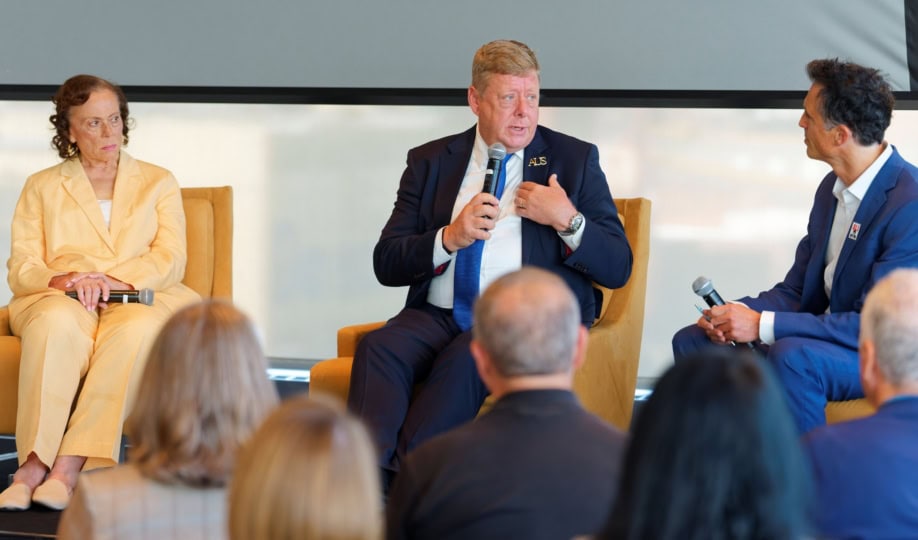
LOUISVILLE, KY (August 28, 2026) — The Muhammad Ali Center hosted a special conversation on leading in crisis, the power of values-driven decision-making and the enduring relevance of Muhammad Ali’s legacy in today’s world at an exclusive event for civic, business and community leaders at the Muhammad Ali Center yesterday, August.27.
Lonnie Ali, Co-Founder, President and CEO, Muhammad Ali Center, and Dr. Tod Laursen, Chancellor of the American University of Sharjah, a private university in Sharjah, United Arab Emirates, reflected on the significance of compassion in leadership.
This conversation revealed significant key insights as part of the Muhammad Ali Index, the compassion-based initiative of the Muhammad Ali Center, highlighting findings from the international study debuting with the global launch in 2027.
Highlights from the conversation, insights from the Muhammad Ali Index, and high-res photos are below.
Lonnie Ali on her husband’s role in confronting global crises: “Muhammad Ali was one of those kinds of people that presidents and leaders naturally would think of in a time of crisis who could best represent the United States. And Farah [Pandith] said it very well. It’s a good thing that people, young people, think of Muhammad as what America is and what America should be.”
On leading a university through regional conflict, Tod Laursen said: “One thing about this conflict, if you live in the Middle East and look at the ethnicity and demography of the people who work for us, the sad truth is that well over half of them are from countries where this kind of thing has been a given for a long time. Then there were folks like us, like me, who were going through something like this firsthand for the first time. So part of it was realizing that you had a range of emotions out there, a range of experiences, and people’s feelings were very different about this… There are some people who need to be treated in different ways, and I think having the flexibility as a leader to be able to do that, to be empathetic, to hear out what’s bothering them and try to be responsive where you can, is an important thing in all this.”
Sharjah is the first city globally to commission its own compassion report. Early findings from the upcoming Muhammad Ali Index across the Middle East and North Africa include:
- Faith-based networks are the most reliable crisis infrastructure: When global crises hit, migration flows, political instability, economic collapse. Faith-based organizations and networks spanning multiple denominations are stepping in.
- Oil-backed wealth is moving into long-term soft power: Gulf States are strategically repositioning themselves as stable, values-driven actors amid global volatility. Social investment is part of this play.
- A cultural shift is underway across the Middle East and North Africa (MENA) region: asking for help is starting to be seen as a sign of strength.
- Across MENA, communities are directly supporting migrant populations and vulnerable groups through informal safety nets.
On the Muhammad Ali Index, Laursen said: “Our goal here is going to be to give mayors, give leaders, give sheikhs in our case, recommendations that are backed by data, yes, but that are actionable. And that can be actioned in a manner that is sensitive to the culture in which they’re being applied. I think we’ve got a pretty good shot at this because my boss is Sheikha Bodour bint Sultan Al Qasimi, President of the American University of Sharjah, and this is something we’ve talked a lot about.”
He added: “She knew that we would have an opportunity as an institution, with our strong relationships across Sharjah, to have this not just be a piece of work that goes on the shelf, but something that we could actually act on and respond to… And particularly if you can make a good argument as to how it will be beneficial to the Emirates, there’s a good chance of being able to put things into practice.”
Lonnie Ali on partnering with higher education and engaging with students: “I think it’s through them that we will see a turn in the tide in the way this country is going and the way the world is going, because they don’t want to live in conflict all of their lives or at odds with people.”
Photos below. Credit Ryan Armbrust/Muhammad Ali Center.
Lonnie Ali, Tod Laursen and Simon Cohen
Lonnie Ali and Tod Laursen
Lonnie Ali
About the Muhammad Ali Center
The Muhammad Ali Center is a 501(c)(3) that prides itself on being much more than a museum. As an athlete, a humanitarian, a global voice and man guided by faith, Muhammad Ali embodied a pursuit and belief in the greatness found in all people. Founded in 2005 by Lonnie and Muhammad Ali in his hometown of Louisville, the Center is dedicated to honoring Ali and continuing work based on his core principles.